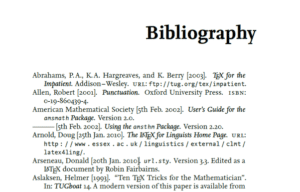
Bibliographies and works cited are not the same. Bibliographies include all the sources you consulted in your research whether or not you cite or mention them at all in your research paper. Your works cited should include only the sources that you cite. Professors will ask for bibliographies when they want to review all the research you conducted to prepare for the paper.
Do not try to “wow” your instructor with a long bibliography when your instructor requests only a works cited page. It is tempting, after doing a lot of work to research a paper, to try to include summaries on each source as you write your paper so that your instructor appreciates how much work you did. That is a trap you want to avoid. MLA style, the one that is most commonly followed in high schools and university writing courses, dictates that you include only the works you actually cited in your paper—not all those that you used.
Academic Writing, Editing, Proofreading, And Problem Solving Services
Get 10% OFF with 24START discount code
Assembling Bibliographies and Works Cited
If your assignment calls for a bibliography, list all the sources you consulted in your research.
If your assignment calls for a works cited or references page, include only the sources you quote, summarize, paraphrase, or mention in your paper.
If your works cited page includes a source that you did not cite in your paper, delete it.
All in-text citations that you used at the end of quotations, summaries, and paraphrases to credit others for their ideas,words, and work must be accompanied by a cited reference in the bibliography or works cited. These references must include specific information about the source so that your readers can identify precisely where the information came from.The citation entries on a works cited page typically include the author’s name, the name of the article, the name of the publication, the name of the publisher (for books), where it was published (for books), and when it was published.
The good news is that you do not have to memorize all the many ways the works cited entries should be written. Numerous helpful style guides are available to show you the information that should be included, in what order it should appear, and how to format it. The format often differs according to the style guide you are using. The Modern Language Association (MLA) follows a particular style that is a bit different from APA (American Psychological Association) style, and both are somewhat different from the Chicago Manual of Style (CMS). Always ask your teacher which style you should use.
A bibliography usually appears at the end of a paper on its own separate page. All bibliography entries—books, periodicals, Web sites, and nontext sources such radio broadcasts—are listed together in alphabetical order. Books and articles are alphabetized by the author’s last name.
Most teachers suggest that you follow a standard style for listing different types of sources. If your teacher asks you to use a different form, however, follow his or her instructions. Take pride in your bibliography. It represents some of the most important work you’ve done for your research paper—and using proper form shows that you are a serious and careful researcher.
Bibliography Entry for a Book
A bibliography entry for a book begins with the author’s name, which is written in this order: last name, comma, first name, period. After the author’s name comes the title of the book. If you are handwriting your bibliography, underline each title. If you are working on a computer, put the book title in italicized type. Be sure to capitalize the words in the title correctly, exactly as they are written in the book itself. Following the title is the city where the book was published, followed by a colon, the name of the publisher, a comma, the date published, and a period. Here is an example:
Format: Author’s last name, first name. Book Title. Place of publication: publisher, date of publication.
Examples:
A book with one author: Hartz, Paula. Abortion: A Doctor’s Perspective, a Woman’s Dilemma. New York: Donald I. Fine, Inc., 1992.
A book with two or more authors: Landis, Jean M. and Rita J. Simon. Intelligence: Nature or Nurture? New York: HarperCollins, 1998.
Bibliography Entry for a Periodical
A bibliography entry for a periodical differs slightly in form from a bibliography entry for a book. For a magazine article, start with the author’s last name first, followed by a comma, then the first name and a period. Next, write the title of the article in quotation marks, and include a period (or other closing punctuation) inside the closing quotation mark. The title of the magazine is next, underlined or in italic type, depending on whether you are handwriting or using a computer, followed by a period. The date and year, followed by a colon and the pages on which the article appeared, come last. Here is an example:
Format: Author’s last name, first name. “Title of the Article.” Magazine. Month and year of publication: page numbers.
Examples:
Article in a monthly magazine: Crowley, J.E.,T.E. Levitan and R.P. Quinn.“Seven Deadly Half-Truths About Women.” Psychology Today March 1978: 94–106.
Article in a weekly magazine: Schwartz, Felice N.“Management,Women, and the New Facts of Life.” Newsweek 20 July 2006: 21–22.
Signed newspaper article: Ferraro, Susan. “In-law and Order: Finding Relative Calm.” The Daily News 30 June 1998: 73.
Unsigned newspaper article: “Beanie Babies May Be a Rotten Nest Egg.” Chicago Tribune 21 June 2004: 12.
Bibliography Entry for a Web Site
For sources such as Web sites include the information a reader needs to find the source or to know where and when you found it. Always begin with the last name of the author, broadcaster, person you interviewed, and so on. Here is an example of a bibliography for a Web site:
Format: Author.“Document Title.” Publication or Web site title. Date of publication. Date of access.
After completing the bibliography you can breathe a huge sigh of relief and pat yourself on the back. You probably plan to turn in your work in printed or handwritten form, but you also may be making an oral presentation. However you plan to present your paper, do your best to show it in its best light. You’ve put a great deal of work and thought into this assignment, so you want your paper to look and sound its best. You’ve completed your research paper!


 Bibliographies and works cited are not the same. Bibliographies include all the sources you consulted in your research whether or not you cite or mention them at all in your research paper. Your works cited should include only the sources that you cite. Professors will ask for bibliographies when they want to review all the research you conducted to prepare for the paper.


